You land in Florence with a single carry-on and exactly 48 hours to absorb five centuries of Renaissance art, architecture, and pasta. The city is compact — you can walk from the Duomo to the Arno in twelve minutes — but the line at the Uffizi can eat three of those hours if you show up unprepared. This itinerary assumes you have no time to waste and no interest in spending half your trip queueing.
Day One: The Duomo, David, and the Medieval Core
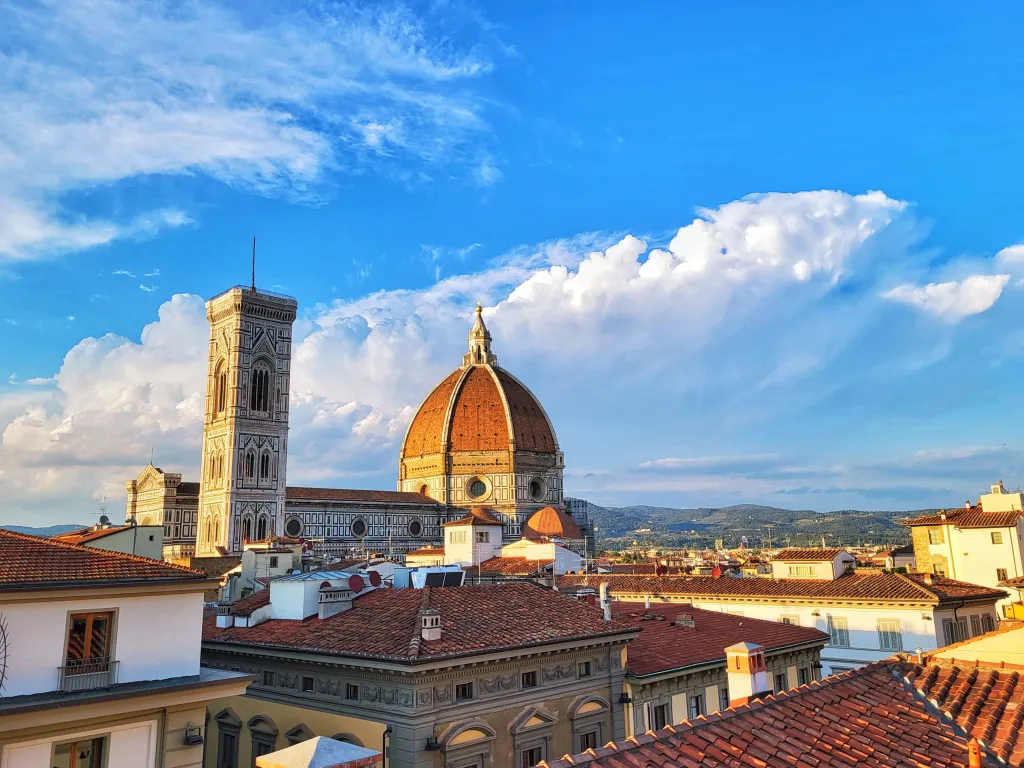
Start at 8:00 AM. The Piazza del Duomo is empty before nine, and the morning light hits the marble facade of Santa Maria del Fiore in a way that photographs cannot replicate. You have two choices: climb the 463 steps of Brunelleschi’s Dome, or skip the climb and enter the cathedral for free. Do the climb. The view from the top is the single best orientation point in Florence — you see the entire city grid, the hills of Fiesole, and exactly where you’ll walk later.
Buy your Brunelleschi Pass (€30, includes dome climb, baptistery, Giotto’s bell tower, and the museum) online at least three days before. Same-day tickets sell out by 10 AM from March through October.
The Baptistery and Giotto’s Bell Tower
After the dome, cross the piazza to the Baptistery. The gold-leaf mosaics on the ceiling — particularly the massive Last Judgment — are worth ten minutes of neck strain. Then climb Giotto’s Bell Tower (414 steps, no elevator). It’s a different perspective than the dome: closer to the rooftops, less vertigo, and you see the dome itself from above.
Total time for the Duomo complex: 2 hours. If you move fast, 90 minutes.
The Accademia Gallery: David Without the Crowds
Walk ten minutes north to the Accademia Gallery. Book the earliest entry slot — 8:15 AM if possible. Michelangelo’s David dominates the main hall. The room is designed so you see the sculpture from the end of a long corridor, and the perspective makes David look larger than his actual 17 feet. Most visitors spend 45 minutes here. That is enough. The unfinished Slaves (also by Michelangelo) are in the same hall, and they show exactly how he worked: figures emerging from raw marble like prisoners breaking stone.
Ticket: €16. Book directly from the Accademia website. Third-party resellers charge €25–€35 for the same entry.
San Lorenzo Market and Lunch
By noon, walk to the Mercato Centrale. The ground floor is a traditional food market with fresh produce, cheese, and butcher stalls. The upstairs is a food hall with about twenty stalls. Get a lampredotto sandwich from Nerbone (ground floor, stall 292, €7). Lampredotto is the fourth stomach of a cow, slow-cooked in broth with herbs. It sounds intimidating. It tastes like the best braised beef you’ve ever had.
Afternoon: Santa Croce and the Oltrarno
Cross the Arno via the Ponte Vecchio. The bridge is crowded at all hours, but the goldsmith shops have been there since the 16th century, and the view upriver toward the Santa Trinità bridge is the classic Florence postcard. Do not buy gold here unless you have a specific piece in mind and know the price of gold per gram. The markups are steep.
On the south bank (Oltrarno), visit the Basilica of Santa Croce. This is the burial church of Galileo, Machiavelli, and Michelangelo. The entry fee is €11, and the cloister is quieter than the Duomo’s. The Pazzi Chapel, designed by Brunelleschi, is a perfect example of Renaissance proportion — the room is a cube topped by a hemisphere, and every measurement relates to every other measurement by simple ratios.
Walk up to the Piazzale Michelangelo for sunset. The walk takes 20 minutes from Santa Croce, uphill but not punishing. The view is the one you see on postcards: the Duomo, the Palazzo Vecchio, the Arno, and the hills beyond. Bring water. The vendors at the top charge €4 for a 500ml bottle.
Dinner: book a table at Trattoria Cammillo (Borgo San Jacopo, 57) or Osteria Santo Spirito (Piazza Santo Spirito). Both serve classic Florentine cuisine — bistecca alla fiorentina (€55–€70 per kilo, usually served as a 1.2kg cut for two people) and ribollita (a bread and vegetable soup, €12).
Day Two: The Uffizi, Palazzo Vecchio, and What You Missed
Day two is the Uffizi day. The gallery holds the single best collection of Renaissance painting in the world. It also holds the longest lines. Book the 8:15 AM slot. The gallery opens at 8:15, and the first hour is the only time you can see Botticelli’s Birth of Venus without ten people deep in front of you.
Ticket: €25 (€38 with temporary exhibitions). The Uffizi website accepts bookings up to two months in advance. For summer visits, book at least three weeks ahead.
What to See in the Uffizi in 2.5 Hours
Do not try to see everything. The museum has 101 rooms. Focus on these:
- Room 2 (Giotto): the Maestà altarpiece. This is the painting that broke Byzantine flatness and started the Renaissance.
- Room 10–14 (Botticelli): Primavera and Birth of Venus. The details — the orange blossoms, the shell, the wind god Zephyr — repay close looking.
- Room 26 (Michelangelo): the Doni Tondo, a circular painting of the Holy Family. It shows Michelangelo’s sculptural approach to painting: the figures look carved.
- Room 66 (Leonardo): the Annunciation and the unfinished Adoration of the Magi. Leonardo’s sfumato technique (soft, smoky transitions between colors) is obvious here.
- The Corridoio Vasariano: a 1km elevated passageway that connects the Uffizi to the Pitti Palace. It is only open on guided tours (€25 extra, book through the Uffizi website). The corridor is lined with 1,000+ self-portraits, including Rembrandt and Velázquez.
Exit through the gift shop and walk directly to the Loggia dei Lanzi in the Piazza della Signoria. The sculptures there — including Giambologna’s Rape of the Sabine Women — are originals, not copies. They have stood in the open air since the 16th century.
Palazzo Vecchio and the Secret Passages
The Palazzo Vecchio is Florence’s town hall. The Salone dei Cinquecento (Hall of the Five Hundred) is a 54-meter-long room built for the city council. Vasari painted the ceiling frescoes, and the room contains Michelangelo’s Victory sculpture. The guided tour of the secret passages (€15, 60 minutes) takes you through hidden staircases and small rooms used by the Medici family. You see the Studiolo of Francesco I, a tiny windowless room covered in Mannerist paintings. This tour requires booking — the groups are limited to 15 people.
Standard entry to the Palazzo Vecchio: €12.50. Combined ticket with the secret passages: €22.
Afternoon: Choose Your Finale
You have roughly four hours before your flight or train. Pick one of these three options depending on your interests:
Option A: The Pitti Palace and Boboli Gardens (3 hours). The palace has six museums. The Palatine Gallery contains Raphael’s Madonna della Seggiola and Titian’s portraits. The Boboli Gardens behind the palace are a 16th-century formal garden with fountains, statues, and a view of the city from the hilltop. Ticket: €16 for the palace and gardens combined.
Option B: The Bargello Museum (1.5 hours). This is the sculpture museum. It holds Donatello’s David (the first free-standing nude since antiquity), Michelangelo’s Bacchus, and Ghiberti’s competition panels for the Baptistery doors. Ticket: €11. No crowds. This is the museum that locals recommend.
Option C: The Brancacci Chapel (45 minutes). Masaccio’s fresco cycle of the life of Saint Peter is the foundational work of Renaissance painting. The Expulsion from the Garden of Eden panel shows Adam and Eve with an emotional intensity that no earlier painting achieved. The chapel is in the Santa Maria del Carmine church, a 15-minute walk from the Pitti Palace. Entry: €6. Booking is required.
Common Mistakes That Waste Time and Money
This section covers the errors that first-time visitors make repeatedly. Avoid them and you gain 3–4 hours of usable time.
Mistake 1: Showing up at the Uffizi or Accademia without a reservation. The line for non-reserved tickets at the Uffizi averages 90 minutes in April, 2.5 hours in July. The reservation fee is €4. Pay it. The same applies to the Accademia. The €4 reservation fee is the best value in Florence.
Mistake 2: Buying a Firenze Card without checking the math. The Firenze Card costs €85 and gives access to 72 museums for 72 hours. If you are in Florence for less than two days, you will visit at most 4–5 museums. The Uffizi (€25) + Accademia (€16) + Palazzo Vecchio (€12.50) + Pitti Palace (€16) = €69.50. The card costs €15.50 more than individual tickets. Do the math before buying.
Mistake 3: Eating at a restaurant with a menu in six languages. The restaurants on the Piazza della Signoria and the Duomo piazza pay 30–50% commissions to tour operators and hotel concierges. The food is average, the prices are high, and the tiramisu came from a freezer. Walk two blocks off the main piazzas. Look for restaurants where the menu is in Italian only and the handwritten daily specials are on a chalkboard.
Mistake 4: Trying to see both the Uffizi and the Accademia on the same morning. The Uffizi requires 2.5–3 hours minimum. The Accademia requires 45 minutes to 1 hour. If you book both at 8:15 AM, you will be rushing through the second museum. Book the Uffizi for day one morning and the Accademia for day two morning, or vice versa.
Mistake 5: Staying in a hotel near the train station. The area around Santa Maria Novella station is convenient for transport but has few restaurants and feels empty after 9 PM. Stay in the Oltrarno (south of the river) or near Santa Croce. The walk to the Duomo is 10–15 minutes, and you are surrounded by trattorias and wine bars.
When to Skip a Museum or Monument
This is the honest advice that most travel guides omit. Not every famous site is worth your limited time.
Skip the Giotto’s Bell Tower if you already climbed the dome. The view is similar, and the 414 steps are exhausting. Do one or the other. Do the dome.
Skip the Medici Chapels if you are not a Michelangelo fan. The New Sacristy contains Michelangelo’s Night and Day sculptures, but the rest of the complex is a 17th-century chapel with standard Baroque decoration. The entry fee is €12. The Bargello Museum gives you more Michelangelo for less money.
Skip the Leonardo Interactive Museum. It is a small space with wooden models of Leonardo’s inventions. The models are reproductions. The information is basic. It costs €12 and takes 30 minutes. The real Leonardo works are in the Uffizi.
Skip the wine windows (buchette del vino). These are small openings in the walls of old palaces where wine was sold during the 16th century. There are about 150 of them in Florence. A few are still used by restaurants to serve wine to the street. The novelty wears off after two. Do not plan your itinerary around finding them.
Budget Breakdown for a Two-Day Trip
| Item | Cost (€) | Notes |
|---|---|---|
| Brunelleschi Pass (Duomo complex) | 30 | Valid 72 hours, includes dome climb |
| Uffizi Gallery ticket | 25 | Add €4 reservation fee |
| Accademia Gallery ticket | 16 | Add €4 reservation fee |
| Palazzo Vecchio (standard) | 12.50 | Secret passages tour: €15 extra |
| Santa Croce | 11 | |
| Pitti Palace + Boboli Gardens | 16 | Optional, choose one afternoon activity |
| Bargello Museum | 11 | Alternative to Pitti Palace |
| Brancacci Chapel | 6 | Alternative to Bargello |
| Meals (3 lunches, 2 dinners) | 80–120 | Street food lunch ~€10, sit-down dinner ~€35 |
| Public transport (bus/tram) | 3–6 | Single ticket €1.50, valid 90 minutes |
| Total (with all main sites) | €200–€245 | Excluding accommodation and flights |
If you skip the Pitti Palace and choose the Bargello instead, subtract €5. If you skip the Palazzo Vecchio secret passages tour, subtract €15. The minimum viable budget for museum entry alone is about €100.
The Verdict: This Itinerary Works If You Move Fast
Two days in Florence is not enough to see everything. It is enough to see the essential works of the Renaissance — David, the Birth of Venus, the Duomo, the Ponte Vecchio — and still have time for one deep-dive museum and one neighborhood walk. The key is booking every major ticket in advance and accepting that you will skip the Medici Chapels, the Galileo Museum, and the Bardini Garden. Those are for the return trip.
For a first visit with 48 hours, this itinerary gives you the core of Florence without the wasted time. Book the Uffizi for 8:15 AM on day two. Climb the dome at 8:00 AM on day one. Eat lampredotto at the Mercato Centrale. And do not buy a Firenze Card.