If you only see one perched village in Provence, make it Moustiers-Sainte-Marie. Not because it’s the most famous — that’s Gordes. Not because it’s the most photographed — that’s Roussillon. Moustiers wins because it sits at the mouth of the Verdon Gorge, has a functioning ceramics industry that dates back to the 1600s, and costs roughly 40% less than its Luberon counterparts for accommodation in peak season.
This article covers what to actually do there, how to budget, when to avoid the worst crowds, and why skipping it is a mistake if you’re driving the Route des Crêtes.
Why Moustiers-Sainte-Marie Is Different From Other Perched Villages
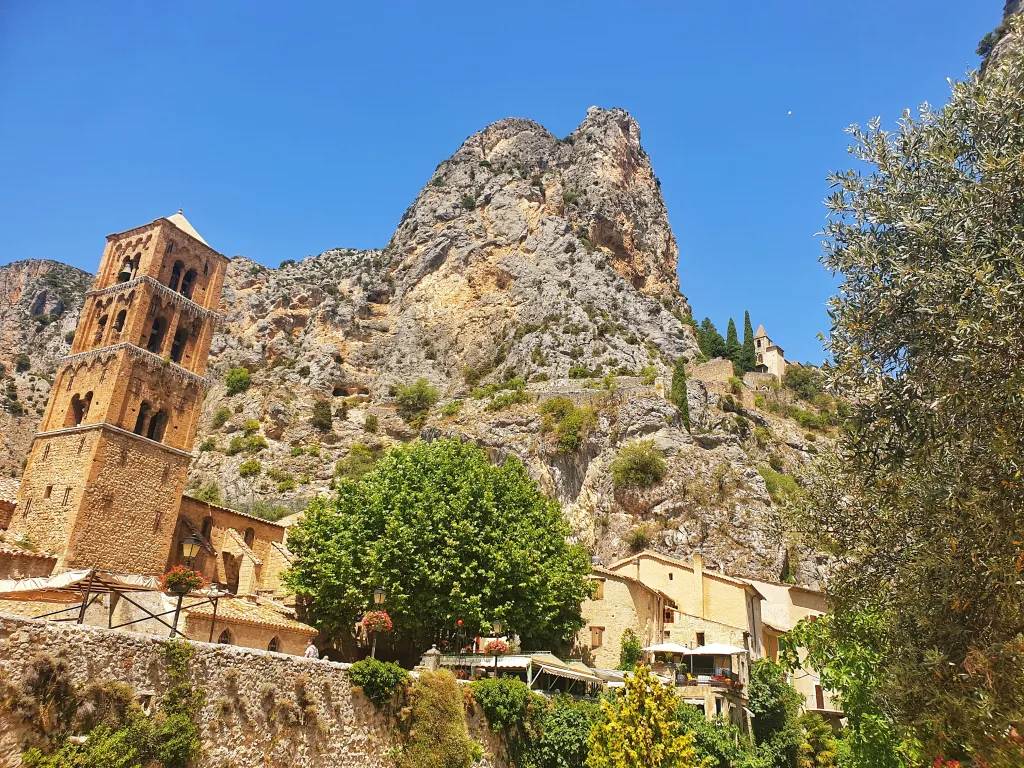
Most perched villages in Provence share the same formula: narrow stone streets, a church on top, a view of lavender fields. Moustiers has all that. But it also has a 227-meter waterfall that flows year-round, a star suspended on a chain between two cliffs, and the Verdon Gorge right at its doorstep.
The star is the first thing you notice. A gold-painted, five-pointed star hangs on a 135-meter iron chain stretched between two cliffs above the village. Nobody knows exactly how old the original was — local tradition says a knight hung it after returning from the Crusades. The current star dates to 1955. It’s visible from almost anywhere in the village.
The ceramics are the second reason to come. Moustiers faience — tin-glazed earthenware — has been produced here since 1668. At its peak in the 18th century, 18 factories operated in the village. Today, about a dozen workshops remain. The Musée de la Faïence (€5 entry, open daily June–September) holds 2,000 pieces dating from 1680 to the present.
What this means for you: Moustiers works as a half-day stop or a base for 3–4 days of hiking and kayaking. Most Luberon villages don’t offer that range.
How to Get There and Where to Park
Moustiers sits in the Alpes-de-Haute-Provence department, about 90 minutes northeast of Aix-en-Provence. The drive is the point — the Route des Crêtes (D952) from Aiguines to Moustiers is one of the best scenic roads in France.
By car: The only practical option. Nearest train stations are Manosque (45 minutes south) and Digne-les-Bains (50 minutes north). Both have rental car desks. Parking in Moustiers is tight. There are three main lots:
- Parking du Pré (free, 120 spaces) — fills by 10:00 AM July–August
- Parking de la Poste (€3/day, 80 spaces) — central but small
- Parking du Cimetière (free, 200 spaces) — 10-minute walk uphill, empties later
By tour bus: Half-day tours from Nice or Aix run €60–€90 per person. They stop at Moustiers for 90 minutes, then drive the Verdon Gorge. That’s enough time for a coffee, a ceramic shop, and a photo of the star. Not enough for a hike or kayak.
When to drive: The D952 from Moustiers to Castellane has hairpin turns and occasional sheep herds. Allow 45 minutes for the 35 km stretch. Do not attempt in a large camper van — the tunnel de Fayet has a 2.8-meter height limit.
Moustiers-Sainte-Marie Budget Breakdown
Here is what a two-night trip costs for one person in July 2026. Prices are from booking.com and local restaurant menus as of May 2026.
| Item | Budget (€) | Mid-Range (€) | Splurge (€) |
|---|---|---|---|
| Hotel (2 nights) | 110 | 240 | 480 |
| Meals (2 lunches, 2 dinners) | 60 | 120 | 200 |
| Kayak rental (half-day) | 35 | 45 | 65 |
| Museum entry | 5 | 5 | 5 |
| Parking (2 days) | 0 | 6 | 6 |
| Total | €210 | €416 | €756 |
One big cost to watch: Kayak rental on Lac de Sainte-Croix. The lake is 3 km from Moustiers. In August, the cheapest kayak (Base Nautique de la Cadeno, €35 for 3 hours) books out by 9:30 AM. Show up at 11:00 and you’ll pay €55 for a paddleboard from a private vendor. Reserve online 48 hours ahead.
Hotels in Moustiers proper — inside the medieval walls — cost 30–50% more than rooms in La Palud-sur-Verdon, 12 km east. If you have a car, stay in La Palud and drive to Moustiers for dinner.
What to Do in Moustiers: The Three Non-Negotiables
Walk the Chemin de la Chapelle Notre-Dame de Beauvoir
This is the hike everyone does. 262 stone steps from the village square up to the 12th-century chapel. Takes about 15 minutes. The view from the top covers the entire village, the Verdon valley, and the cliffs on both sides. The chapel itself is small — 10 pews, a wooden altar, a few ex-voto paintings. Entry is free. Go at 8:00 AM before the heat hits. By 10:00 AM, the steps are one-way traffic.
Kayak the Verdon Gorge
This is the reason to stay overnight. A half-day kayak trip from the Pont du Galetas bridge takes you into the gorge itself. The water is turquoise — Pantone 2975 C, if you want the exact shade. The cliffs rise 300 meters on both sides. No motorboats are allowed past the first kilometer. You’ll paddle through the Styx du Verdon, a narrow passage where the cliff walls are 6 meters apart.
Rent from Base Nautique du Verdon (€45 per kayak for 4 hours, includes life jacket and dry bag). Bring water shoes — the pebble beaches are sharp. Do not attempt this in a rainstorm. The water level rises fast and the current picks up. Check the Météo-France forecast for Castellane before you go.
Buy One Piece of Moustiers Faience
Skip the tourist shops on the main street. Walk up Rue de la Bourgade to Atelier de l’Olivier (open 10:00–12:30, 14:00–18:00, closed Sunday). They still fire pieces in a wood-burning kiln. A small plate with the traditional “blue and yellow” pattern costs €28. A serving platter runs €85. The glaze is lead-free — safe for food. The Musée de la Faïence sells reproductions of 18th-century designs starting at €15.
What not to buy: The €5 ceramic magnets sold at the tourist office. They’re made in China. Check the back of any piece — authentic Moustiers faience has “Moustiers” or the workshop name stamped into the clay.
When to Go and When to Stay Home
Moustiers has three distinct seasons. Pick wrong and you’ll spend your trip in a traffic jam or a closed restaurant.
July and August: Peak season. The village gets 4,000–5,000 visitors per day. Parking fills by 9:00 AM. Restaurants require reservations 3 days ahead. Kayak rentals sell out by 10:00 AM. Temperatures reach 35°C by 2:00 PM. The lavender fields near Valensole (20 minutes south) are in full bloom, which is the only reason to tolerate the crowds. If you come in August, book everything — hotel, kayak, dinner — at least two weeks in advance.
May, June, and September: The sweet spot. 1,000–2,000 visitors per day. Parking is easy until 11:00 AM. Kayak rentals available same-day. Restaurants have walk-in tables. Lavender blooms mid-June to mid-July. Water temperature in the lake is 18–22°C — swimmable but brisk. This is when locals take their own vacations in the village.
October through April: Quiet. Many restaurants close November–March. The kayak rental bases shut down entirely. The waterfall runs stronger. The star is still there. The Musée de la Faïence is open but on reduced hours (10:00–12:00, 14:00–17:00). Hotel prices drop to €50–€70 per night. If you want solitude and don’t care about water activities, February is the best month — clear skies, 10°C daytime highs, and you’ll have the chapel to yourself.
One week to absolutely avoid: The third week of July, when the Lavender Festival in Valensole brings 20,000 people into the area. The D952 becomes a parking lot from 10:00 AM to 4:00 PM.
Common Mistakes People Make Visiting Moustiers
Having watched hundreds of tourists cycle through this village over ten visits, here are the errors I see most often.
Mistake 1: Treating it as a drive-by photo stop. The tour buses stop at the viewpoint below the village for 15 minutes. You get a photo of the star and the rooftops. You miss the ceramics, the chapel, and the waterfall. If you only have an hour, skip the viewpoint and walk up to the chapel instead. The view is better and you’ll see the star from above.
Mistake 2: Eating lunch at the main square. The three restaurants on Place de l’Église charge €18 for a salad that costs €12 one street over. Walk 200 meters up Rue de la Bourgade to Le Petit Verdon. Their menu du jour — starter, main, dessert — is €22. The terrace overlooks the ravine. Reservations recommended even in June.
Mistake 3: Not bringing cash. About 40% of the ceramics workshops and smaller bakeries don’t accept cards. The nearest ATM is at the post office, which runs out of cash by Saturday afternoon in summer. Bring €50–€100 in small notes.
Mistake 4: Wearing sandals on the chapel steps. The stone steps are worn smooth by 800 years of foot traffic. After 11:00 AM, they’re slick with sunscreen and sweat. I’ve seen three people slip in a single July afternoon. Wear closed-toe shoes with grip.
Mistake 5: Skipping the waterfall. The Cascade de Moustiers is a 5-minute walk from the parking du Cimetière. It drops 22 meters into a pool you can wade in. Most tourists don’t know it exists. The trail is marked “Cascade” on Google Maps. Go at 4:00 PM when the sun hits the water.
Alternatives: When Moustiers Isn’t the Right Choice
Moustiers is excellent for most travelers. But it’s not for everyone. Here’s when you should pick something else.
Skip Moustiers if you have mobility issues. The village is built on a 30-degree slope. The chapel steps alone are 262 stairs. Only two restaurants have ground-floor access. The tourist office offers a map of accessible routes, but they’re limited. For flatter terrain with similar charm, go to L’Isle-sur-la-Sorgue. It’s flat, has canals, and the Sunday antique market is the best in Provence.
Skip Moustiers if you want nightlife. The village has three bars. Two close by 10:00 PM. The third is a hotel bar that serves only hotel guests after 11:00 PM. For evening activity, stay in Aix-en-Provence or Nice and day-trip to Moustiers. The drive is long (90 minutes from Aix) but doable.
Pick the Luberon instead if you want luxury. Gordes has the Airelles Bastide de Gordes (€800+/night) with a spa and Michelin-starred restaurant. Moustiers has La Bastide de Moustiers (€180/night, three-star, good but not luxury). The Luberon villages — Gordes, Roussillon, Ménerbes — have more high-end shopping, wine tours, and starred restaurants. Moustiers has better nature and lower prices.
Pick Castellane if you want the gorge without the crowds. Castellane sits at the eastern entrance of the Verdon Gorge. It has fewer tourists, cheaper parking (free in most lots), and the same kayak access. The village itself is less photogenic — Moustiers is prettier by a wide margin — but if your priority is the gorge, Castellane is a better base.
The Verdict: Who Should Go and How to Do It Right
Moustiers-Sainte-Marie is the best single village base for exploring the Verdon Gorge and the Haute-Provence lavender fields. It beats every Luberon village for outdoor access and beats every lakeside town for charm.
For the hiker and kayaker: Stay two nights at La Palud-sur-Verdon (€70/night at Hotel des Gorges du Verdon). Day one: kayak the gorge from 8:00 AM to 12:00 PM, then drive the Route des Crêtes in the afternoon. Day two: hike the Sentier Blanc-Martel (8 hours, 15 km, requires a headlamp for the tunnels) and eat dinner in Moustiers.
For the photographer and food traveler: Stay one night in Moustiers proper (€120/night at Hotel Les Santolines). Arrive at 4:00 PM, walk the chapel steps at golden hour, buy ceramics the next morning, and leave by 11:00 AM before the tour buses arrive.
For the day-tripper: Park at Parking du Cimetière by 8:30 AM. Walk to the waterfall (10 minutes), climb to the chapel (15 minutes), buy a ceramic piece (20 minutes), and have a coffee at Café de la Place (€2.50 for an espresso). Leave by 10:30 AM. You’ll have seen the best of it without the crowds.
Book your kayak and dinner reservations 48 hours ahead in June and September, two weeks ahead in July and August. Bring cash. Wear proper shoes. Do not skip the waterfall.