
The misconception that trips up families before every vacation: “ride-on” and “carry-on” are marketing terms, not guarantees. A suitcase can absolutely be both — but only when its specific dimensions fall within your specific airline’s size policy, and those policies vary more than any product listing will tell you.
Here’s the situation that plays out in airports constantly. A parent buys a ride-on suitcase for their four-year-old, the child names it and rides it around the living room for three weeks, and then at check-in the gate agent measures it and sends it to the hold. The child walks. The whole point of the product disappears.
What follows is a breakdown of size rules by airline, an honest look at age limits, and specific product recommendations — in that order.
Why Carry-On Size Rules Are More Complicated Than the Box Suggests
Most ride-on kids’ suitcases are labeled as carry-on compatible. Very few confirm which specific airlines’ policies they actually match. That gap is where trips go sideways.
The Trunki Original — the most recognized ride-on suitcase in the world — measures 46x31x21cm and holds about 18 liters. It sits comfortably within most major full-service carrier limits. British Airways allows 56x45x25cm overhead bags. Delta allows 56x35x23cm. Southwest sets its limit at 61x41x25cm. The Trunki fits all three with room to spare.
But Ryanair’s personal item limit for passengers without priority boarding is 40x20x25cm. The Trunki is wider, taller, and deeper than that. Without a priority boarding ticket, it goes in the hold. The same applies to Wizz Air’s base tier. Budget carriers operate by different rules, and the consequence is real: you pay $10–$20 per person per flight for priority boarding, or the bag gets checked.
The Ridaz sports car-shaped suitcases — including the Ferrari F12 and Lamborghini Aventador editions — run larger at approximately 54x30x21cm. They fit Southwest and British Airways. But Emirates caps carry-on depth at 20cm, putting the Ridaz over limit. Singapore Airlines runs the same 55x38x20cm policy. If your family flies Asian carriers regularly, the Trunki’s smaller profile is significantly safer.
| Airline | Carry-On Size Limit | Trunki (46x31x21cm) | Ridaz (54x30x21cm) |
|---|---|---|---|
| British Airways | 56x45x25cm | Fits | Fits |
| Delta | 56x35x23cm | Fits | Fits |
| Southwest | 61x41x25cm | Fits | Fits |
| Emirates | 55x38x20cm | Borderline (21cm depth) | Does not fit |
| Singapore Airlines | 55x38x20cm | Borderline (21cm depth) | Does not fit |
| Ryanair (no priority) | 40x20x25cm | Does not fit | Does not fit |
| Ryanair (with priority) | 55x40x20cm | Fits | Borderline (54cm length) |
What “fits” actually means at the gate
Published airline size limits are maximums, not comfort guarantees. Gate agents measure inconsistently depending on flight load and bin availability. A bag exactly at the published limit is not the same as one comfortably below it. The Trunki at 46x31x21cm leaves roughly 10cm of margin on most major carriers — that’s real buffer. The Ridaz at 54cm has 1–2cm of theoretical clearance on a 55cm limit. That is not comfortable padding; it’s a number that can go either way depending on who’s at the gate that day.
Budget airlines change the math — verify before you buy
On Ryanair and Wizz Air, the economics of a ride-on suitcase shift significantly. Even with priority boarding, which unlocks Ryanair’s 55x40x20cm limit, you’re paying extra per person per direction. On a round trip with two adults and two children, that’s potentially $80–$120 in priority fees just to maintain carry-on status for what you already bought. Some families find this acceptable. Others decide to check the bag and skip the fee — which means no riding in the terminal regardless, and the whole calculation collapses.
The Ride Frame Cuts Real Volume From Inside the Bag
The shell that lets a child sit on a Trunki is structural — it cannot be removed or compressed. The result: 18 liters of actual packing space in a bag measuring 46x31x21cm externally. A soft-sided suitcase of the same external dimensions would hold 22–24 liters. That 4–6 liter difference equals roughly two days of a small child’s clothing. For a 3-night trip, the Trunki works fine. For five nights or more, you will be checking a second bag regardless — which means the “carry-on” designation stops mattering to the overall trip plan.
Age and Weight Limits: What the Packaging Doesn’t Actually Tell You
The box says ages 3 to 6. The riding weight limits tell a more precise story.
The 18kg riding weight limit on the Trunki
The Trunki Original supports a maximum of 18kg of rider weight. The average 3-year-old weighs 13–15kg. The average 5-year-old weighs 18–21kg. Most children can ride comfortably from around age 2.5 to age 4.5. By age 5, many exceed the limit — and riding past it risks cracking the polypropylene shell or snapping the fabric harness clip under the seat. The “ages 3–6” range on the packaging reflects safe walking use of the suitcase, not safe riding use.
The Ridaz suitcases publish a 25kg rider limit, which extends the riding phase to roughly age 6–7. If your child is already 5, the Ridaz is the better purchase based purely on how many more trips you’ll get actual riding use from.
What happens after kids outgrow the ride-on feature
The Trunki becomes a small rolling suitcase. At 18 liters, it’s undersized for a school-age child managing their own bag — a 7-year-old going on a 4-day trip cannot pack what they need in 18 liters. Most parents find the Trunki shifts to bedroom toy storage or dress-up prop around age 6–7 rather than continuing as active travel gear.
The Ridaz holds up slightly better after the riding phase ends. Its 22-liter capacity and more conventional suitcase silhouette make it usable as a carry-on for a 7-year-old. Still small, but functional for shorter trips.
What airport riding actually looks like in practice
Children between ages 2.5 and 4 are enthusiastic riders. They sit on the harness frame, hold the ear-handles, and get pulled through terminals while parents walk at normal adult pace. This genuinely solves the “I’m too tired to walk” problem that derails airport journeys with toddlers — it’s not a novelty item, it’s a functional solution for a specific age window.
Children aged 5 and up increasingly want to pull their own bag and walk independently. The riding feature becomes something parents suggest rather than something kids demand. If your child is already 5, buy them a real carry-on spinner and move on.
Two Ride-On Suitcases Worth Buying
Two brands make ride-on kids’ suitcases with genuine durability and airline-tested dimensions. Everything in the sub-$40 range on discount sites uses thin polystyrene shells and plastic rollers that crack within three airport trips.
| Product | Dimensions | Rider Weight Limit | Volume | Price (approx.) | Best For |
|---|---|---|---|---|---|
| Trunki Original (Terrance / Trixie / Rosie + 20 designs) | 46x31x21cm | 18kg | 18L | $65–$75 | Ages 2.5–4.5, most major full-service carriers |
| Ridaz Ferrari F12 / Lamborghini Aventador | 54x30x21cm | 25kg | 22L | $89–$109 | Ages 4–7, US and European full-service carriers |
Trunki Original: the right default for most families
The Trunki Original comes in over 25 character designs — Terrance is the classic orange tiger, Trixie is pink ladybug, Rosie is red, and there are unicorn, dinosaur, and animal designs to cover nearly every child preference. All share the same 46x31x21cm shell, 18kg rider limit, and 18-liter packing capacity. The wheels are smooth polyurethane, not brittle plastic — they handle airport tile without the bouncing and chattering that makes dragging generic kids’ luggage miserable. The harness strap attachment lets a parent pull the child on the bag while walking at full adult pace.
At $65–$75, this is the right buy for children aged 2.5 to 4.5 flying major carriers. Go in with realistic expectations: 2 to 4 years of riding use, then repurpose it.
Ridaz: for kids who have outgrown the Trunki weight limit
The Ridaz Ferrari F12 Berlinetta and Lamborghini Aventador are licensed hard-shell carry-ons shaped like sports cars. Kids straddle the car body rather than sitting on a flat surface, which most children aged 5–7 find significantly more exciting than a standard suitcase silhouette. Four 360-degree spinner wheels make it genuinely easy to maneuver through a terminal at full walking pace.
At $89–$109 depending on design and retailer, the Ridaz costs more, holds more at 22 liters, and supports heavier riders up to 25kg. The trade-off: at 54cm long, you need to confirm your airline’s specific policy before ordering. On full-service carriers with 55cm or greater limits it fits. On Emirates or Singapore Airlines’ 55x38x20cm depth restriction, the 21cm depth puts it over limit — and “marginally over” at a gate is still over.
Five Situations Where You Should Skip the Ride-On Entirely
- Your child is under 2.5 years old. Sitting on a ride-on suitcase requires balance and grip strength that most children under 2.5 don’t have reliably. You’re also likely managing a stroller — adding a ride-on suitcase creates more complexity than it removes.
- You’re flying budget carriers without factoring in priority boarding costs. On Ryanair, Wizz Air, or Spirit, priority boarding adds $10–$20 per person per direction. On a four-person round trip, that’s $80–$160 in fees to maintain carry-on status for the ride-on bag. Know the full fee total before you buy.
- You’re traveling solo with two young children. You can pull a child sitting on a Trunki, or you can hold a second child’s hand. You cannot do both simultaneously without a second adult. Solo parent, two kids under 5 — skip the ride-on.
- You’re packing for more than four nights. The 18-liter capacity of the Trunki covers a 3-to-4-day kids’ packing list, rolled tightly. Beyond four nights, you’re checking a bag regardless. The carry-on framing of the product becomes irrelevant.
- Your child is 6 or older. Most kids this age want the independence of pulling their own bag. A standard 20-inch kids’ spinner works better and lasts longer. The American Tourister Wavebreaker 20” ($69) and the Samsonite Cubelite 55cm Spinner ($85–$95) both fit major carrier overhead bins, hold significantly more than any ride-on suitcase, and won’t become outgrown by age 7.
How to Pack a Ride-On Carry-On Without Needing a Second Bag
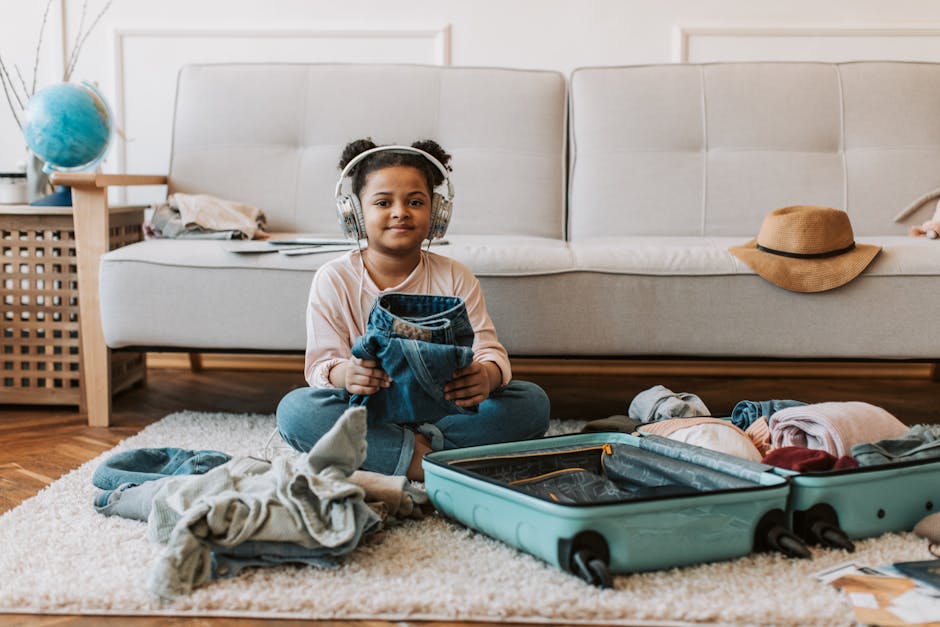
Eighteen liters is a real constraint. This packing sequence works for a 3-to-4-day trip with a child aged 3–5.
- Shoes at the base, near the wheels. Weight goes low for riding stability and rolling balance. Packing shoes at the top means they shift against soft items every time the bag tips.
- Roll every piece of clothing. A rolled toddler T-shirt takes roughly 40% less space than a folded one. Three days of clothing for a 3-year-old — 3 outfits, pajamas, 4 socks, 2 pairs of underwear — runs about 7–8 liters rolled tight.
- Toiletries in a small clear ziplock near the top. Sunscreen, toothbrush, toothpaste, a small tube of kids’ shampoo. Pack it last so you can reach it at security without unpacking the rest of the bag.
- Use the Trunki’s saddle clip for a day bag. The harness point on the back of the Trunki is designed to hold a light drawstring bag or small backpack while the child rides. Use it for snacks, a stuffed animal, or a tablet in a soft sleeve. This adds 3–5 liters of accessible storage without touching the suitcase’s internal volume.
- Weigh the packed bag before leaving home. Most airlines set carry-on weight limits at 7–10kg. A packed Trunki with 3 days of a toddler’s clothing typically runs 4–6kg — comfortably within limits. Confirm this at home rather than at the check-in desk.
For a 3-night trip with a child aged 3 to 4 flying a major full-service carrier: the Trunki Original at $65–$75 is the correct buy. For a child aged 5 to 7, or for a slightly longer trip where the extra 4 liters makes a real difference, the Ridaz Ferrari or Lamborghini edition at $89–$109 extends both the rider weight limit and the packing capacity — provided your airline’s carry-on limit is 55cm or greater. For budget carriers or trips beyond 4 nights, skip the ride-on category and buy a standard hard-shell kids’ spinner instead.