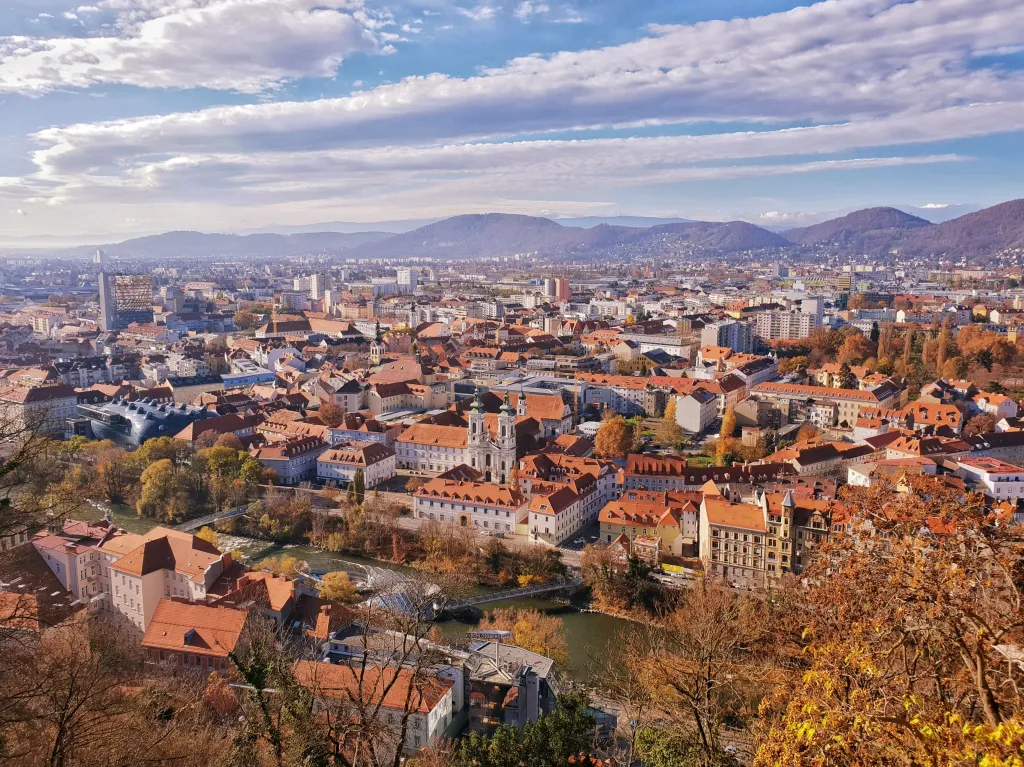
Most people assume Graz is just a smaller, quieter version of Vienna. That’s wrong. Graz has its own rhythm, its own food culture, and one of the best-preserved medieval city centers in Europe — without the tourist crowds of Salzburg or the imperial weight of Vienna. It’s also the only Austrian city that feels genuinely Mediterranean. The courtyards, the roof tiles, the wine taverns spilling onto cobblestone streets. You can cover the essentials in two days, but you need a plan to avoid wasting time on stuff that looks good on Instagram and delivers nothing.
Why Graz Feels Different From Every Other Austrian City
Graz sits at the southern edge of Austria, just a short drive from Slovenia. The climate is warmer. The architecture shifts from Gothic to Renaissance to Art Nouveau. The food leans toward pumpkin seed oil, cured ham, and sour wines. It’s the capital of Styria, a region that calls itself “Austria’s green heart” — and they mean it. Vineyards start right at the city limits.
The core difference is attitude. Graz is a university city with six universities and over 60,000 students. That means cheap eats, late-night bars, and a creative energy that Vienna lost decades ago. The Kunsthaus (the “friendly alien” building) isn’t just a museum — it’s a symbol of how this city treats contemporary design as normal, not precious.
The Schlossberg is the city’s natural anchor. A 473-meter hill with a clock tower at the top, it offers the best view of the red-tiled rooftops. You can hike up in 15 minutes or take the glass elevator from the city center (€2.20 one way). The hill has a few restaurants and a beer garden, but the real value is the panorama at sunset.
What most guides won’t tell you: the Schlossberg is free to access. The clock tower (Uhrturm) is free to photograph from outside. The paid attractions on the hill — the bastion museum and the bell tower — are skippable unless you’re a military history enthusiast. Save your €8 and spend it on a Brettljause (cold meat platter) at a nearby Heurigen instead.
The 48-Hour Itinerary That Actually Works
This schedule assumes you arrive Friday evening and leave Sunday afternoon. It avoids the two biggest time-wasters: queueing for the Kunsthaus (book ahead) and walking the entire Schlossberg loop (take the elevator up, walk down).
| Time | Activity | Cost |
|---|---|---|
| Friday 18:00 | Check into hotel near Hauptplatz or Lendplatz | €80–€150/night |
| Friday 19:30 | Dinner at Der Steirer (Burggasse 4) — Styrian classics, €12–€20 main | €25–€35/person |
| Saturday 09:00 | Breakfast at Aiola Upstairs (Schlossberg elevator top station) — best view + coffee | €10–€15 |
| Saturday 10:30 | Walk down Schlossberg → explore Altstadt (Hauptplatz, Landhaushof, Sporgasse) | Free |
| Saturday 13:00 | Lunch at Glöckl Bräu (Glockenspielplatz) — brewery with courtyard seating | €15–€20 |
| Saturday 15:00 | Kunsthaus Graz (book tickets online, 1.5–2 hours) | €12 |
| Saturday 18:00 | Murinsel (artificial island on the Mur river) — free to walk across | Free |
| Saturday 20:00 | Dinner at Freigeist (Lendplatz) — modern Austrian, €18–€28 mains | €35–€45 |
| Sunday 09:00 | Brunch at Bauernmarkt Kaiser-Josef-Platz (farmers market, Sat–Sun only) | €8–€12 |
| Sunday 11:00 | Eggenberg Palace (20-min bus ride from Hauptbahnhof, 2 hours) | €13.50 |
| Sunday 14:00 | Depart | — |
A few notes on timing. The Kunsthaus takes longer than you expect — the building itself is the main exhibit, and the interior spaces are disorienting. Give yourself 90 minutes minimum. Eggenberg Palace is a 30-minute bus ride from the main train station (bus 630, €2.40). The palace gardens are free, the interior tour is paid. Skip the interior if you’ve seen any Habsburg palace before. The gardens alone justify the trip.
The One Tourist Trap You Should Skip
The Graz Clock Tower (Uhrturm) is the symbol of the city. It’s on every postcard, every magnet, every keychain. And it’s genuinely beautiful. But the Clock Tower Museum inside it is a waste of €5.50. Three small rooms with dusty exhibits about clock mechanisms and a few old photos. The view from outside is identical to the view from inside. You lose nothing by skipping the interior.
A bigger trap: the Graz City Train (Bimmelbahn). It’s a small tourist train that loops around the Altstadt for €8 per person. It takes 25 minutes and shows you streets you can walk in 10 minutes. The audio guide is recorded in flat, robotic English. Skip it entirely. Walk instead.
What’s actually worth paying for? The Murinsel is free, but the cafe inside it charges €4.50 for a coffee. That’s fine — the coffee is decent, and the view of the river from the glass walls is unique. Pay for the experience, not the caffeine.
Where Locals Eat (and Where Tourists Overpay)
Graz has a strong food culture that doesn’t rely on tourist traps. The two main local dishes are Käferbohnen (large brown beans with pumpkin seed oil) and Schilcher (a tart rosé wine from the region). Both are cheap, filling, and hard to find outside Styria.
For a proper Styrian lunch, go to Der Steirer (Burggasse 4). It’s a Gasthaus that’s been running since 1890. The menu changes daily. Order the Brettljause (€14.50) — a wooden board piled with cured ham, speck, cheese, pickles, and fresh horseradish. It’s enough for two people. Pair it with a glass of Schilcher (€3.80).
For dinner, Freigeist (Lendplatz 10) is the best modern Austrian restaurant in the city. The menu is short — six mains, two desserts. The roasted chicken with pumpkin seed crust (€22) is the standout. Book ahead on weekends.
For cheap eats, hit Lendplatz Market (Saturday mornings). The Bauernkrapfen (fried dough pockets filled with jam or cabbage) cost €2 each from the bakery stall. The Käferbohnen salad from the vegetable vendor is €3.50 for a generous portion.
What to avoid: any restaurant on Hauptplatz with a menu in four languages and a waiter standing outside. These places serve frozen schnitzel and charge €18 for it. Walk two streets into the side alleys and you’ll find better food for half the price.
Getting Around Graz Without Wasting Time
Graz is walkable. The entire Altstadt (old town) fits inside a 1.5 km circle. You don’t need a car. You don’t need a taxi. You need comfortable shoes and a willingness to use the public transport for two specific routes.
Route 1: Hauptbahnhof to Hauptplatz. Tram line 1, 4, or 7. Runs every 5 minutes. Takes 8 minutes. Single ticket: €2.40. 24-hour pass: €5.80. Buy the pass at the station — it pays for itself after two rides.
Route 2: Hauptplatz to Eggenberg Palace. Bus 630 from Hauptbahnhof. Runs every 20 minutes on weekends. Takes 25 minutes. Single ticket: €2.40. The bus stop is directly outside the palace gates.
Route 3: Schlossberg elevator. The glass elevator is at the corner of Schlossbergplatz and Sporgasse. It runs daily from 08:00 to midnight. One-way up: €2.20. Round-trip: €3.80. Buy the one-way up and walk down — the path is well-marked and takes 10–15 minutes.
One mistake tourists make: buying the Graz Card (€28 for 48 hours). It includes free public transport and free entry to 20 museums. But unless you plan to visit four museums in two days, the math doesn’t work. The Kunsthaus alone costs €12. Eggenberg Palace costs €13.50. If you only visit those two, the card saves you €2.50 — but you have to pick it up at the tourist office, which takes 20 minutes. Not worth it.
What to Skip If You Have Less Than 48 Hours
If you only have one full day in Graz, cut these three things from your list:
- Eggenberg Palace. It’s 30 minutes outside the city. The gardens are nice, but the interior is a standard Baroque palace. If you’ve seen Schönbrunn or Belvedere in Vienna, you’ve seen this. Skip it and spend the extra time in the Altstadt.
- Kunsthaus interior. The building is worth seeing from the outside. The exhibitions inside change every few months and are often mediocre. Walk around the outside, take a photo, and move on. Save the €12.
- Murinsel cafe. The island itself is a cool architectural piece. Walk across it. Don’t sit down for coffee. The queue is long, the prices are high, and there are better cafes five minutes away on the riverbank.
What you should absolutely not skip: the Schlossberg at sunset, a meal at Der Steirer, and the farmers market on Kaiser-Josef-Platz (Saturday only). Those three experiences cost under €30 total and capture what makes Graz different from every other Austrian city.
Bottom line: Graz delivers more personality per square meter than any other Austrian city its size. The food is cheaper, the crowds are thinner, and the architecture is more varied. You can see the highlights in two days without rushing. The trick is knowing which landmarks to admire from outside and which restaurants to walk past. Stick to the itinerary above, skip the Clock Tower Museum and the tourist train, and you’ll leave with a full stomach and a camera roll that actually matches the postcards.